Skip to content

ART

THE SEAL OF THE DYNASTY.

RENATA NADA’ELENA TURANOVA

ART OF LOUIS XIV.

THE DYNASTY PAINTINGS

My art is not a reconstruction of the past.
It is the re-creation of a principle.

The Dynasty paintings unite the language of the French Baroque with a contemporary visual language of their own. Gold, royal blue, light, ornament, symbol and power become a new aesthetic order.

Each work is one of a kind.

Each work possesses its own identity.

Each work stands for a part of the Dynasty.

Three works.

Three icons.

Three Dynasty paintings.

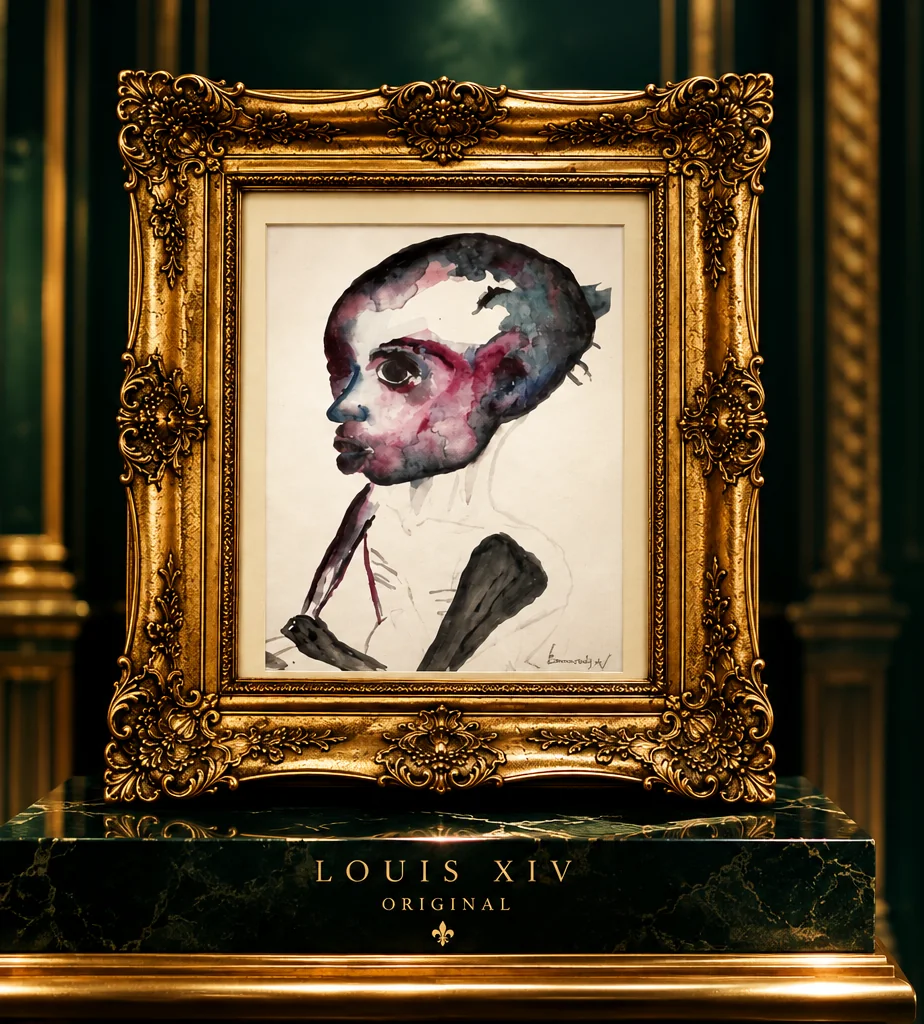
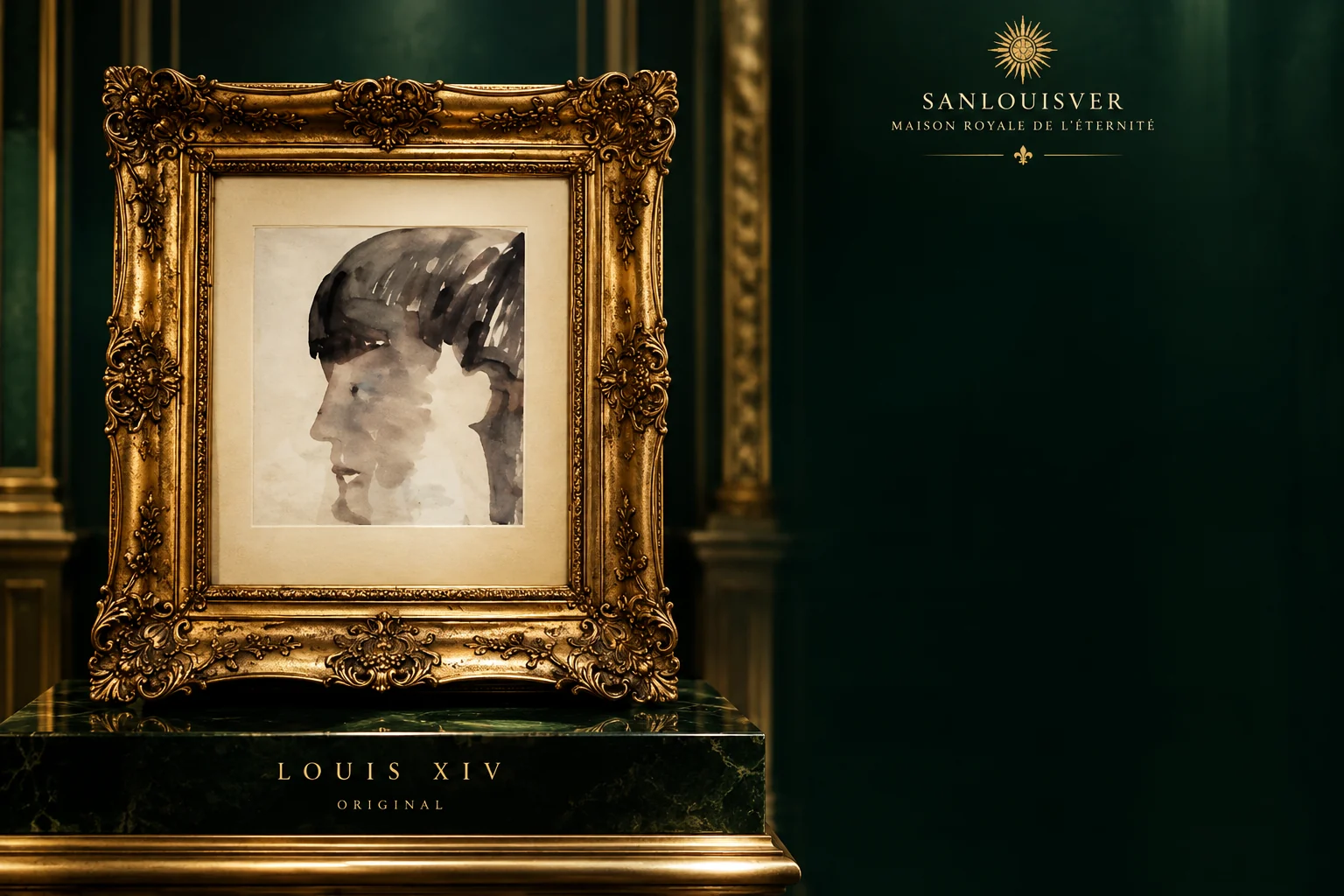
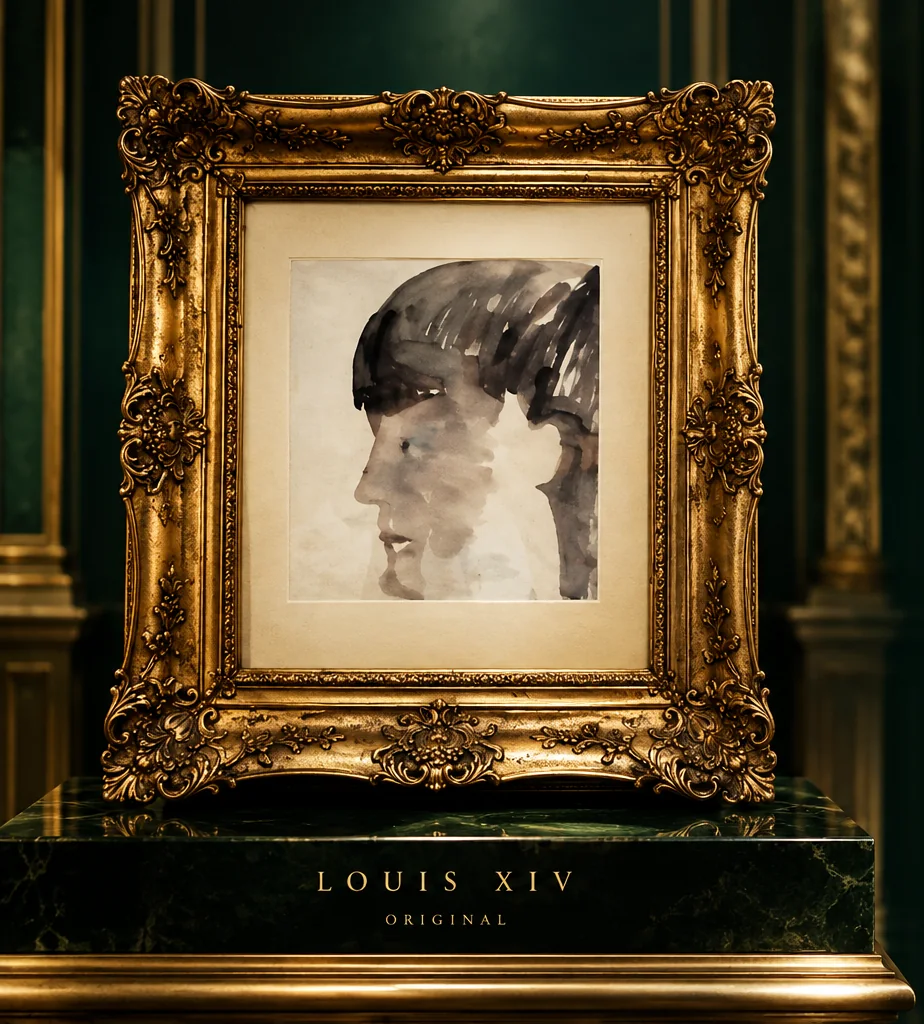
Kopf eines Kindes in a gilded frame on a pedestal of green marble bearing the inscription LOUIS XIV ORIGINAL

KOPF EINES KINDES

TÊTE D’UN ENFANT

ARTIST
Louis XIV
MEDIUM
Watercolour and mixed media on paper
ORIGINAL
Unique work No print. No reproduction. No copy.
FRAME
Historic frame Gilded wood, handcrafted
CONDITION
Excellent condition

PRICE €2,000,000

“A quiet portrait of timeless truth.”

ART ANALYSIS: Kopf eines Kindes

“Kopf eines Kindes”

by Renata Nada’Elena Turanova stands in a clearly traceable art-historical lineage that can be followed back to Albrecht Dürer.

What appears at first glance to be a sensitive, almost silent portrait reveals on closer inspection a precisely calculated order – a construction that translates the visible into measurable proportions.

The basic structure already follows the principle of the golden ratio. The vertical division of the head can be determined as a ratio of about 1 : 1.618. From the crown to the eye line the distance measures roughly 0.618 of the total height, while the remaining part down to the chin takes up about 0.382. The eye line thus becomes – as in Dürer’s strictly constructed self-portraits – the decisive φ nodal point of the picture.

In the horizontal extent a comparable regularity appears: the width of the face corresponds to approximately five eye widths, while the distance between the eyes equals a single eye width.

This classical proportion, already regarded as the ideal measure in the Renaissance, recurs with similar rigour in Dürer’s famous frontal portrait, above all in the Self-Portrait in a Fur-Collared Robe, where the symmetrical axis divides the face into two almost identical halves.

Beyond this, Turanova’s work reveals a graduated order of surfaces that can be described by the Fibonacci sequence (1 : 1 → 2 : 3 → 3 : 5 → 5 : 8). This rectangular structure organises the face into clearly defined zones:

The forehead, at about 0.618, forms the dominant mass, the middle zone (eyes and nose) acts as a mediating unit, while mouth and chin form the concluding, condensed area.

The diagonal axes of tension play a special role. Their points of intersection can be located exactly in three central areas: eye, root of the nose and line of the mouth.

These points form an inner triangle whose proportions approach the ratio 1 : √2 : φ. Here a parallel emerges with the geometric thinking of Dürer, who in his theoretical writings sought to derive beauty from mathematical relations.

The circular form that encloses the head also follows a clear measure: its diameter equals the height of the head (1 : 1).

The centre of this circle lies not exactly in the middle but slightly above the line of the nose – a subtle intervention that enlivens the static balance through a barely perceptible shift.

This deliberate departure from strict symmetry is an element that already shaped the art surrounding Louis XIV, in which order and representation were always complemented by a controlled dynamism.

In comparison with Dürer it becomes clear: whereas he openly pursues the construction and lets the picture appear almost as proof of his theory of proportion, Turanova integrates the same principles into a calmer, less demonstrative visual language.

The geometry remains at work, yet recedes behind the appearance.

Thus a work comes into being that unites two levels: the immediate, sensuous perception of a child’s face and a deeper, hidden order of number and proportion.

Precisely therein lies its art-historical significance:

It takes up the great tradition of the Renaissance and at the same time carries it further – as contemporary proof that the idea of measurable beauty has lost none of its validity.

Kopf eines Kindes – a work by Renata Nada’Elena Turanova

It is more than a picture.

It is a construction of measure, proportion and inner order – carried by that idea which already governed the great ateliers:

That true beauty springs not from chance, but from law.

In “Kopf eines Kindes” this insight is condensed.

Every line follows an invisible geometry, every focal point is set – in balance between intuition and precision.

This work does not speak loudly.

It acts.

Quiet, concentrated, inescapable.

For collectors, gallerists and discerning spaces, a rare opportunity presents itself here:

A picture that asks not only to be looked at but to be understood – and in precisely this unfolds its timeless power.

Do not simply acquire a work of art.

Acquire a system of order that endures through the centuries.

Available for:

  • – Private collection
  • – Gallery exhibition (large format)
  • – Curated presentations

Enquiries and presentations on request.

Louis 14.

Korinack
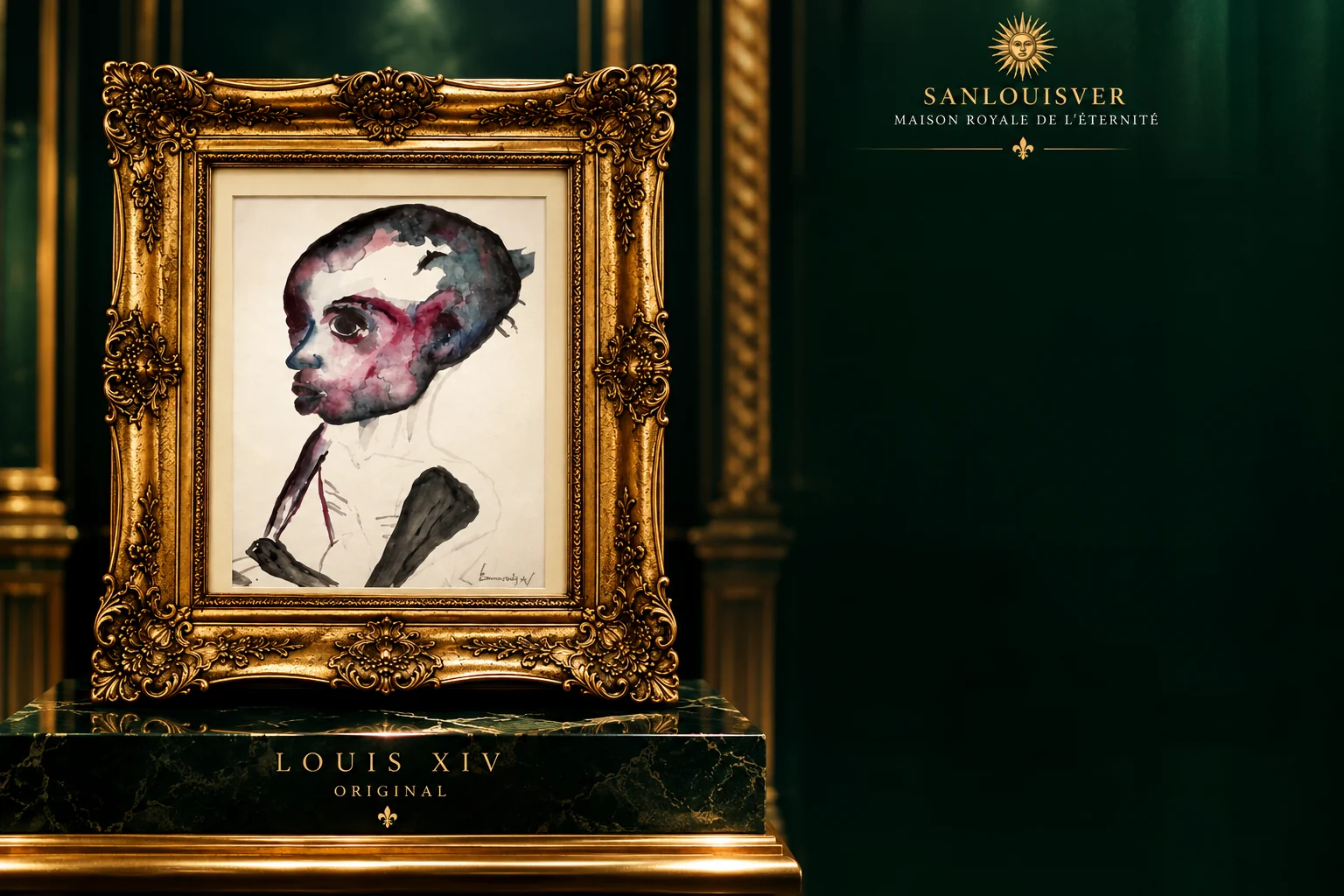
Historie eines Kindes in a gilded frame on a pedestal of green marble bearing the inscription LOUIS XIV ORIGINAL

HISTORIE EINES KINDES

THE HISTORY OF A CHILD

ARTIST
Louis XIV
MEDIUM
Watercolour and mixed media on paper
ORIGINAL
Unique work. No print. No reproduction. No copy.
FRAME
Historic gilded frame
CONDITION
Excellent condition

PRICE €19,000,000

The price for the history of a child.

“A quiet portrait of timeless truth.”

ART ANALYSIS: Historie eines Kindes

In this work, “HISTORIE EINES KINDES”, nothing is left to chance; rather, a strict order reveals itself, founded upon exact measures and well-determined proportions.

Like an edifice of the highest perfection, each measure fits into the other, so that the whole emerges as a necessary appearance.

The countenance – borne by the authority of the portrait and imbued with my own – is set in clear proportions:

The vertical division follows the ratio 1 : 1.618.

From the crown of the head to the eye line, the distance relates to the total height of the head as the smaller part to the larger. Thus the eye becomes the exact point of division – not by chance, but set according to the measure of the golden ratio.

In the same way, the face is divided into precise sections:

  • Hairline to eye line ≈ 0.618 of the total height
  • Eye line to mouth ≈ 0.382
  • Mouth to chin forms the concluding counterpart

In its width the same rigour shows itself:

  • Distance between the eyes = one eye width
  • Total width of the face ≈ 5 eye widths

The central axis divides the face into two equally weighted masses (1 : 1)

The superimposed rectangles follow the Fibonacci sequence: 1 : 1 → 2 : 3 → 3 : 5 → 5 : 8

Each of these rectangles defines a zone:

  • The smallest encloses the eye (centre of tension)
  • The next holds nose and mouth
  • The larger binds forehead and chin into a unity.

The diagonals of these rectangles intersect at precisely determinable points:

  • Point of intersection 1: eye (φ nodal point)
  • Point of intersection 2: root of the nose
  • Point of intersection 3: line of the mouth

These points form an inner triangle whose sides stand in a ratio of approximately 1 : √2 : φ – an order that ensures stability and movement at once.

The circle that encloses the head has a diameter equal to the height of the head (1 : 1).

Its centre lies slightly above the line of the nose – exactly where the vertical and the diagonal order cross.

Thus the masses are not only felt but measured:

  • Forehead as the bearing mass (≈ 0.618)
  • Middle zone as the connecting mass (≈ 0.236)
  • Chin as the concluding mass (≈ 0.146)

Nothing here is undetermined. Every surface, every line, every tension obeys an exact law.

And precisely therein lies the meaning of my art:

That it turns the fleeting into number, the visible into proportion, the individual into a system of eternal validity.

Thus my work rises above the mere portrait and becomes what masters such as Albrecht Dürer and Renata Nada’Elena Turanova/Louis 14. already sought:

Proof that true beauty is measurable – and that in exact measure lies the highest freedom.

KORINACK

Invitation to art collectors.

Dear collectors, lovers of art and keepers of visionary works,

It is my pleasure to invite you to discover this work and my entire artistic research into structure, the golden ratio and the geometry of the living.

This work is not merely a depiction but a system of thought: it understands the human face as a universal architecture in which every proportion becomes language and every measure a key to understanding reality.

Your eye as a collector is not mere contemplation but part of this aesthetic and intellectual construction.

Should this work resonate with your sensibility and your standards, I would be delighted to enter into an exchange regarding an acquisition or a private presentation.

Contact

Please contact me by email: turanova@mail.de

With respect and artistic passion,

Louis 14.

KORINACK

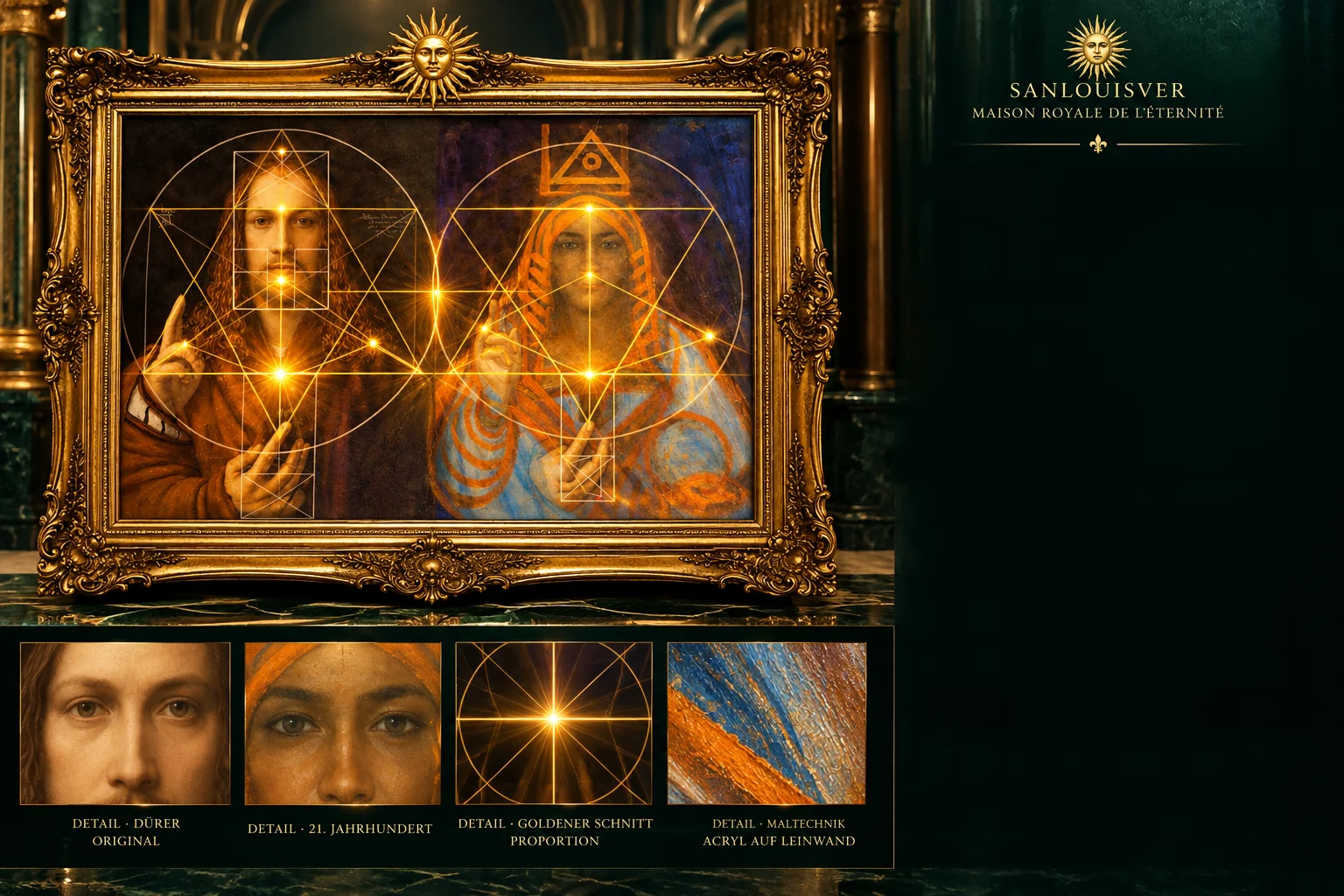
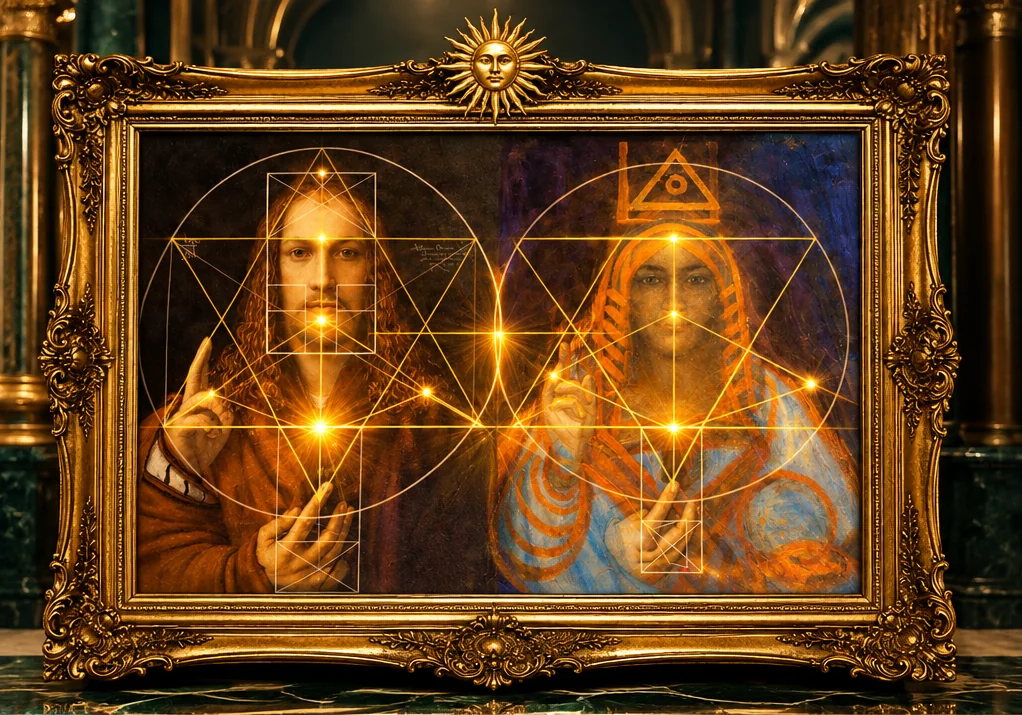
Salvator Mundi after Albrecht Dürer in the 21st century, in a gilded frame on green marble
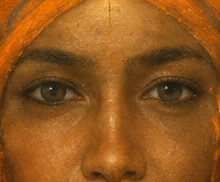
  • Salvator Mundi, detail: eyes and nose of the figure on the left
    DETAIL · DÜRER ORIGINAL
  • Salvator Mundi, detail: eyes and nose of the figure on the right
    DETAIL · 21ST CENTURY
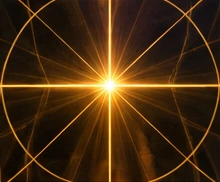
  • Salvator Mundi, detail: a point of light in the circle, divided by golden lines
    DETAIL · GOLDEN RATIO PROPORTION
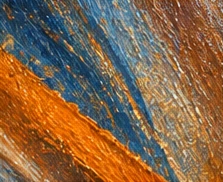
  • Salvator Mundi, detail: brushstrokes in blue and orange
    DETAIL · PAINTING TECHNIQUE, ACRYLIC ON CANVAS

SALVATOR MUNDI AFTER ALBRECHT DÜRER IN THE 21ST CENTURY

TWO EPOCHS · ONE LIGHT · ONE TRUTH

ARTIST
Louis XIV
INSPIRATION
Albrecht Dürer – Salvator Mundi
MEDIUM
Acrylic on canvas
SIZE
Made to the size of the original (c. 100 × 140 cm)
ORIGINAL
Unique work. No print. No reproduction. No copy.
THEME
Two epochs – the union of the Renaissance and the present.
CONDITION
Excellent condition

PRICE €440,000

“The timeless harmony of the divine order unites past, present and future.”

Louis XIV
Salvator Mundi after Albrecht Dürer in the 21st century, the work without its frame
ART ANALYSIS: Salvator Mundi

Salvatore Mundi in the 21st Century.

Renata Nada’Elena Turanova

Concept of the work

This work unites two levels:

  • the classical iconography of the Salvator Mundi
  • a contemporary, deliberately visible geometric construction.

At its centre stands the human being as the interface between spirit and matter, made visible through mathematical order.

Compositional foundation

The work is based on a precise system:

  • Golden ratio (φ ≈ 1.618) as the structural foundation
  • Central vertical axis as the link between above and below
  • Superimposed geometry:
  • Circle (unity / cosmos)
  • Upward triangle (spirit)
  • Downward triangle (matter)

These systems intersect at one central point: the interface of consciousness, action and world

The interface – heart of the work

The luminous centre between the two halves of the picture symbolises:

  • Transformation
  • Connection
  • Flow of energy

Here they meet:

  • Past ↔ present
  • Classical ↔ modern
  • Inner ↔ outer

The work thus visualises a state of transition of the human being in the 21st century

Artistic innovation

Renata Nada’Elena Turanova goes beyond traditional painting:

Geometry is not hidden but deliberately made visible

The construction is part of the statement, not merely a means to an end.

The work unites:

  • Art history
  • Mathematics
  • spiritual symbolism

Result: a contemporary iconic visual language

Why this work matters.

1. Contemporary relevance

The work reflects central questions of our time:

  • Identity
  • Connection between humankind and the world
  • spiritual orientation in the digital age

It is not only aesthetic but highly topical in its content

2. Unique positioning

  • Union of Renaissance principles with modern art
  • the artist’s clear, recognisable signature

This creates a work that is highly recognisable and unique in character

3. Intellectual and cultural value

The picture works on several levels at once:

  • visual
  • mathematical
  • symbolic

It appeals to collectors and institutions alike

It is of museum quality

4. Structural depth

  • Several geometric systems overlap with precision
  • The composition creates a lasting visual impact

The work has a lasting impact, not a superficial one.

Summary

“Salvatore Mundi in the 21st Century” is a work that:

  • unites mathematical precision with artistic expression
  • reinterprets classical iconography
  • shows the human being as the interface between cosmos and reality.

Its value lies in the union of knowledge, symbolism and contemporary relevance.

“This work does not merely show a figure – it shows a system.

A system in which spirit, matter and perception intersect.

It is precisely at this point of intersection that meaning arises – and precisely there lies the value of this work.”

These works are not simply paintings.
They are monuments of an artistic idea, mirrors of power and signs of a new epoch.

My artistic know-how, my unmistakable aesthetic and my international reputation form the foundation of this new language of art.

The Dynasty paintings do not merely preserve a legacy.
They carry it forward.
Not as a copy.
Not as nostalgia.
But as the present.

THE DYNASTY BEGINS.

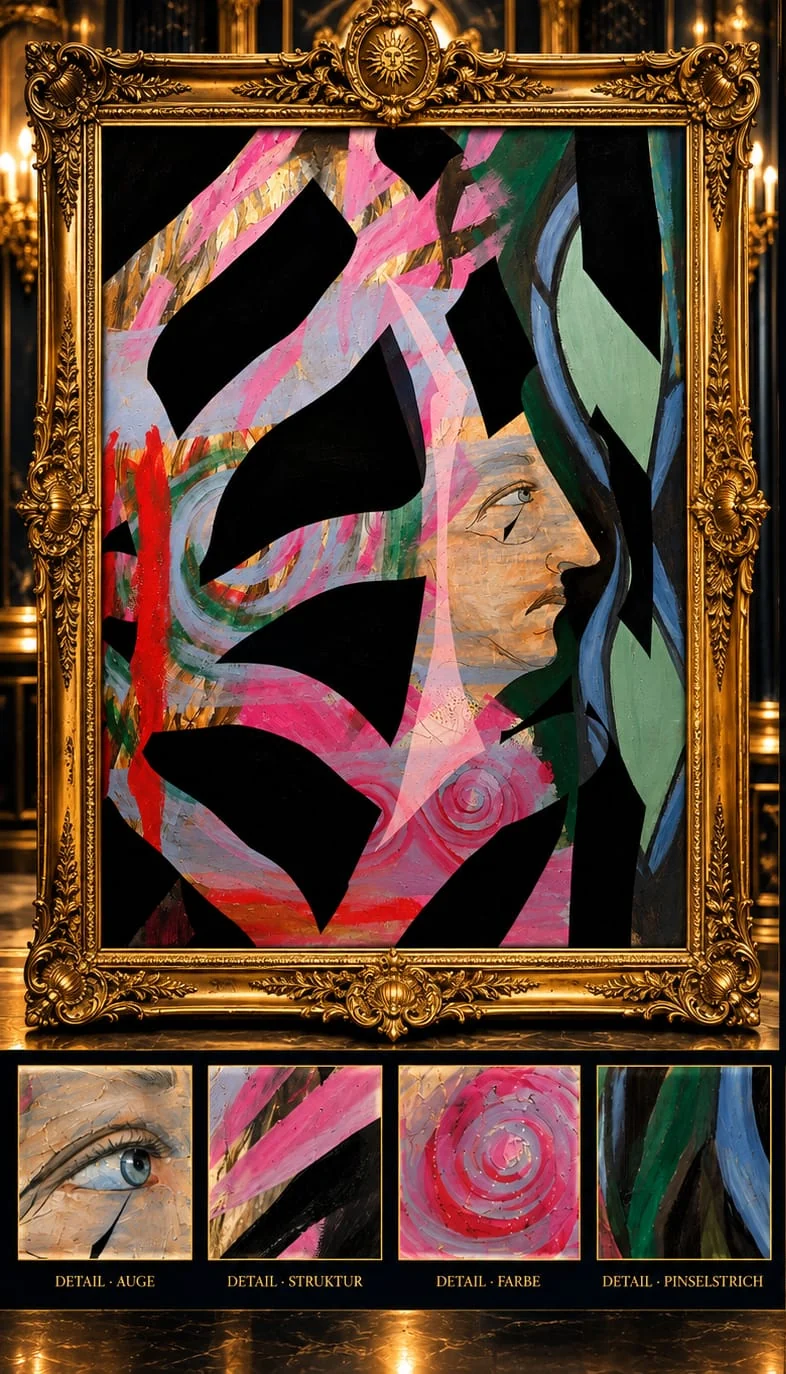
Contemporary original painting – Louis XIV – Contemporary reinterpretation.

Medium: acrylic on canvas

Size: 80 × 60 cm

Original – one of a kind

The work unites abstract painting with a figurative composition. An analysis of the pictorial structure shows several visual references to the proportional principles of the golden ratio. Seven distinctive pictorial elements – the upper contour of the head, the eye, the root of the nose, the tip of the nose, the mouth, the chin and the vertical axis of the face – stand in harmonious relation to the central axes and points of intersection of the composition.

FURTHER WORKS

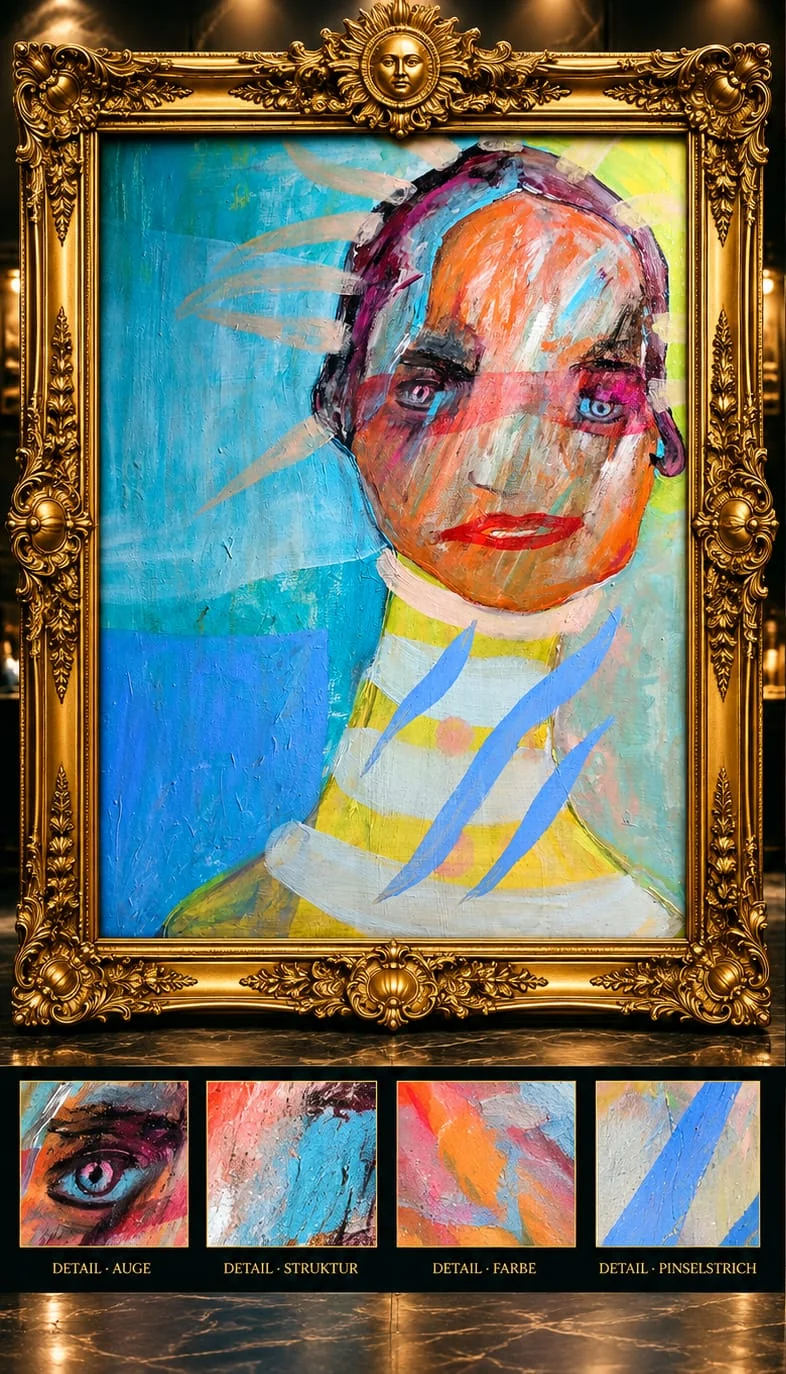
Die stille Würde des Blicks

ART ANALYSIS: Die stille Würde des Blicks

Die stille Würde des Blicks

An expressive portrait study between colour, identity and inner reality

This portrait is far more than the depiction of a human face. It is a painterly investigation of identity – of that invisible level between outward appearance and inner experience. The figure meets the viewer with a calm, almost remote gaze that allows closeness and at the same time keeps its distance. It is precisely this tension that gives the work its psychological depth.

1. The gaze as the centre of the composition

The eyes form the emotional centre of the painting. Their differing treatment in colour – between cool blues and violets and dark contours – creates a subtle tension. The gaze appears thoughtful, watchful and at the same time vulnerable.

The figure does not seem simply to look at the viewer. Rather, the impression arises that it is looking through the visible world. This ambiguity makes the portrait interesting: it offers no unambiguous story, but opens a space for individual interpretation.

2. Colour as an expression of the psyche

The colouring follows no purely naturalistic logic. The face is determined by warm ochre, orange and terracotta tones, which contrast with turquoise, blue, violet and light, almost transparent strokes of colour.

The warm tones give the figure presence and physicality. The cool colours, by contrast, create distance, reflection and a certain weightlessness. Especially appealing is the interplay of luminous orange and turquoise: the two worlds of colour heighten each other’s effect and give the picture a lively, almost vibrating surface.

The light does not appear solely as illumination from outside. It is produced by the painting itself – through layering, contrasts and visible movements of the brush.

3. The visible trace of the artistic process

The manner of painting combines flat areas of colour with gestural, diagonal brushstrokes. The face remains recognisable, yet at the same time is opened up and partly dissolved by the colour.

The light, slanting accents across the forehead, cheeks and nose break through the closed form of the portrait. They create movement and prevent the depiction from freezing into mere likeness.

The background, too, fulfils an active compositional function. The turquoise of the left half of the picture forms a calm counterweight to the intensely coloured figure. The yellowish areas of light in the upper right add a further accent and draw attention back to the head.

The visible texture and the painterly traces deliberately left standing give the work an immediate, crafted presence. The process of painting remains part of the statement.

4. Between figure and abstraction

The painting moves in the field of tension between expressive figuration and free abstraction. The physiognomic features anchor the depiction in the human figure, while the areas of colour and the gestural lines lead beyond a naturalistic rendering.

Especially characteristic is the combination of recognisable form and painterly dissolution. The face is present, but not entirely fixed. The result is a picture that can be read both as a portrait and as an autonomous composition of colour, line and surface.

The neck and chest, striped in yellow and white with blue, dynamic accents, continue the movement of the face in the lower part of the picture. The figure is thus not confined to a static study of a head; the whole surface of the picture is drawn into the expression.

5. The psychological effect

The effect of the work rests essentially on its ambivalence. The facial expression is reserved, while the colours are intense and mobile. From this juxtaposition a quiet tension arises.

The portrait does not tell of a particular event. Rather, it expresses a state: pausing, observing and preserving an inner space.

The viewer may recognise in the figure melancholy, self-assertion, thoughtfulness or quiet resilience. None of these readings is entirely prescribed. Precisely therein lies the strength of an open, psychologically oriented picture.

6. Independence and value to collectors

For buyers interested in art, the work offers several points of entry: an unmistakable colouring, an expressive hand, an immediately recognisable figure and a visual language that is not exhausted in mere depiction.

The tension between warm flesh tones and a cool background makes it carry at a distance. On closer inspection, the painterly layers, the line work and the individual changes within the form of the face come more strongly to the fore.

The work can act as an emotional focal point in a private interior just as well as in a contemporary art collection in which expressive portrait painting and a subjective visual language are valued.

Its effect rests not on decorative pleasingness, but on the interplay of presence, colour and psychological openness.

Concluding reflection

This portrait does not seek a perfect outward likeness. It is interested in the human being as an open, contradictory and many-layered appearance.

The face becomes the place where colour, perception and identity meet. The expressive painting lets the figure appear at once tangible and enigmatic.

The true quality of the work lies in its ability to hold the viewer’s gaze without imposing a single meaning on it. It is a portrait that wants not only to be looked at, but makes an encounter possible.

A work for people who seek in painting not beauty alone, but expression, individuality and a lasting visual dialogue.

Die Wiederkehr des königlichen Kunstprinzips

ART ANALYSIS: Die Wiederkehr des königlichen Kunstprinzips

LOUIS XIV – Die Wiederkehr des königlichen Kunstprinzips

Historical heritage and contemporary vision in dialogue

This work opens an extraordinary dialogue between the cultural heritage of Louis XIV and a contemporary artistic vision that understands royal aesthetics not as a historical memory, but as a living principle of creation.

At its centre stands the fragmented human profile. It appears between coloured bands, geometric breaks and deep black interstices. The face remains recognisable while its surroundings are set in motion. This tension can be read as an emblem of an epoch in which handed-down orders are reinterpreted and historical identity takes on a present-day form.

The geometric structure and the reference to the golden ratio carry the idea of harmony further. They point to the striving for proportion and order that also shaped French art and cultural policy under Louis XIV. Yet in place of the closed Baroque order, a modern visual language appears here: fragmented, expressive and deliberately full of tension.

Louis XIV as a cultural principle

The significance of this work reveals itself especially through the connection with Louis XIV as a patron of the arts and the symbol of an epoch in which art became an instrument of cultural creation. Versailles embodied the aspiration to unite architecture, painting, music and ceremonial into an all-embracing aesthetic vision.

In this contemporary interpretation, that heritage is thought further. Royal art appears not as a closed past, but as a creative impulse for the present. The historical reference thereby gains a new dimension: it stands for continuity, cultural aspiration and the possibility of carrying tradition over into an independent modern form.

Why this work appeals to collectors

Its particular attraction lies in the combination of historical symbolism and a contemporary language of form. The work has an immediate visual character and at the same time opens a conceptual approach to questions of power, identity, harmony and cultural continuity.

For collectors with an interest in Louis XIV, Versailles and the reinterpretation of European art traditions, it thus creates a collecting context of its own. The work can be regarded not only as a portrait, but as part of a broader artistic idea: the carrying of the royal principle of art into the 21st century.

The decisive value lies in this connection of historical memory and present-day creative power. What stands at the centre is not the repetition of a past epoch, but its transformation into a new visual language.

Thus the work becomes an artistic position that connects past and present and interprets the heritage of Louis XIV as a living impulse for the art of our time.

Die Apotheose des königlichen Antlitzes

ART ANALYSIS: Die Apotheose des königlichen Antlitzes

LOUIS XIV – Die Apotheose des königlichen Antlitzes

An art-historical interpretation between Versailles, identity and eternal representation

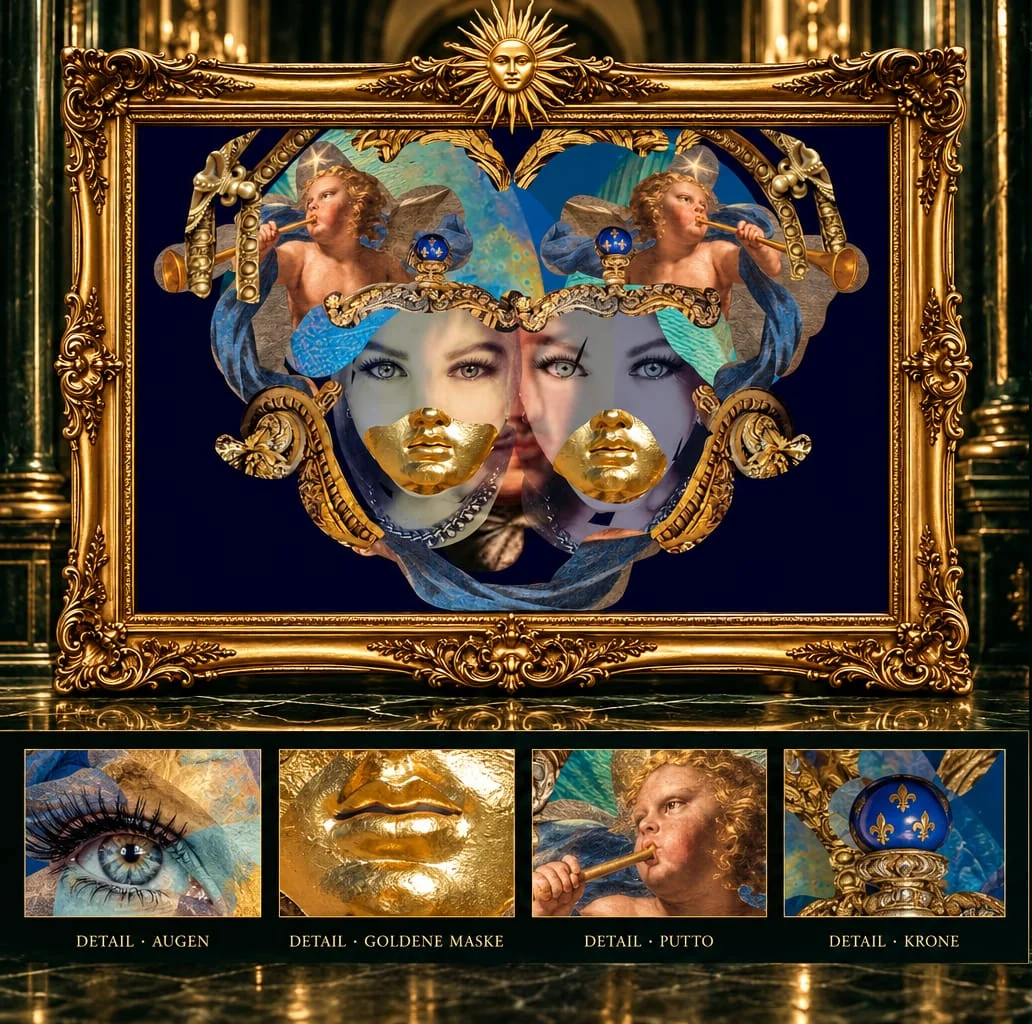
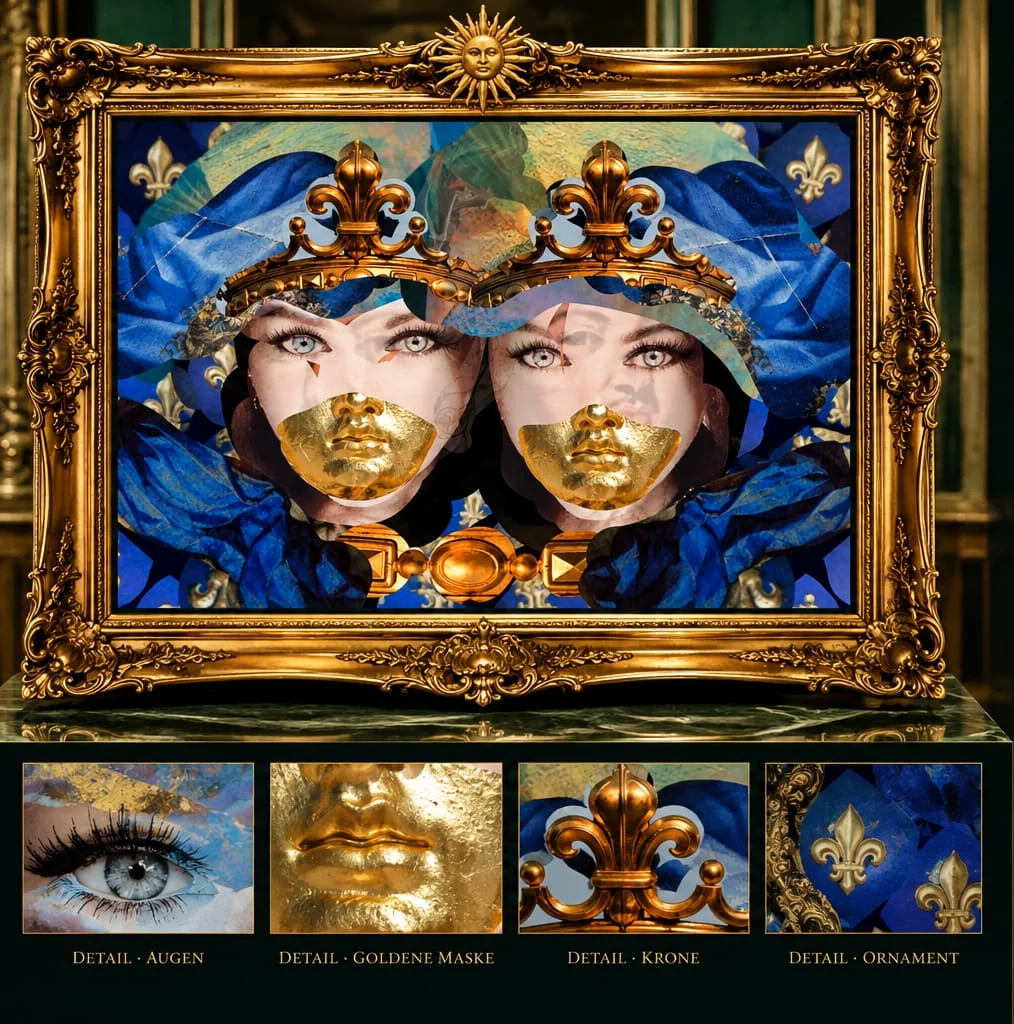
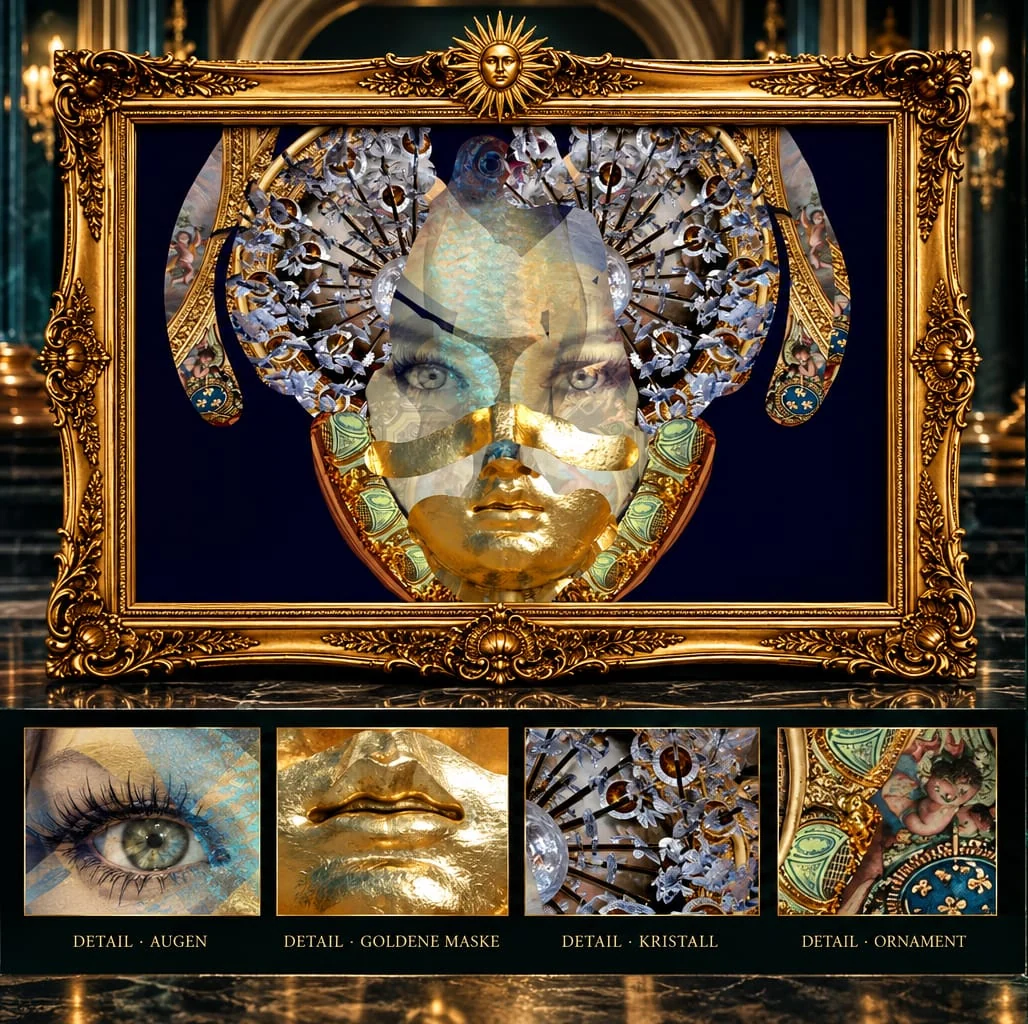
This work unfolds a visual staging of rule, beauty and cultural memory. The human countenance becomes the centre of an ornamental composition in which Baroque splendour, symbolic exaltation and contemporary photomontage merge into an independent artistic statement.

The golden framing recalls the representative aesthetics of European royal courts. Its sculptural ornaments give the picture an almost architectural presence. The dark blue ground heightens the effect of the gold and creates a space in which the face appears as an autonomous emblem. The two winged figures above the central field set a heavenly accent and point to the traditional connection of rule, allegory and transcendence.

The countenance as symbol

The overlaying of several faces forms the conceptual centre of the work. Identity appears not as an unchangeable unity, but as an interplay of different appearances. The golden elements of the face detach themselves from the naturalistic depiction and become mask-like signs. They recall the ceremonial function of the countenance: it is at once individual and public, human and symbolic.

The repetition of the eyes and features creates a tension between mirroring and difference. The picture thus asks about the continuity of identity and about the power of visual representation over time.

Versailles as a cultural principle

In connection with Louis XIV, this composition gains an additional level of meaning. The Sun King understood the arts as an essential part of cultural creation. Versailles became the expression of an order in which architecture, ornament, painting and ceremonial were joined into an all-embracing aesthetic vision.

The work takes up this heritage not through a mere repetition of historical forms. It transforms the Baroque aesthetics of representation into a contemporary visual language. The golden ornaments stand for tradition and permanence; the multiplied faces and the visible layering, by contrast, represent the many layers of modern identity.

Thus a dialogue arises between the historical idea of royal imperishability and a present in which identity is constructed and interpreted anew again and again.

Value to collectors and contemporary relevance

The distinctiveness of the work lies in its combination of historical symbolism, decorative opulence and conceptual ambiguity. It can be read as a homage to European court art, but at the same time as an independent investigation of identity, power and visual staging.

For collectors with an interest in Versailles, Louis XIV and the contemporary reinterpretation of royal aesthetics, the work offers a specific cultural approach. Its golden ornament and the striking central form give it a strong visual presence; the overlaying of the faces moreover opens an intellectual space for interpretation.

Its particular appeal to collectors lies in the transformation of the royal principle of art into a contemporary pictorial idea: historical splendour is not merely quoted, but used as the bearer of a new statement.

The work thus connects the cultural memory of the Baroque with a present-day artistic position – a connection whose significance reveals itself both from the visual effect and from the concept behind it.

Die Metamorphose des königlichen Antlitzes

ART ANALYSIS: Die Metamorphose des königlichen Antlitzes

LOUIS XIV. – Die Metamorphose des königlichen Antlitzes

Between Baroque representation, expressive colour and contemporary identity

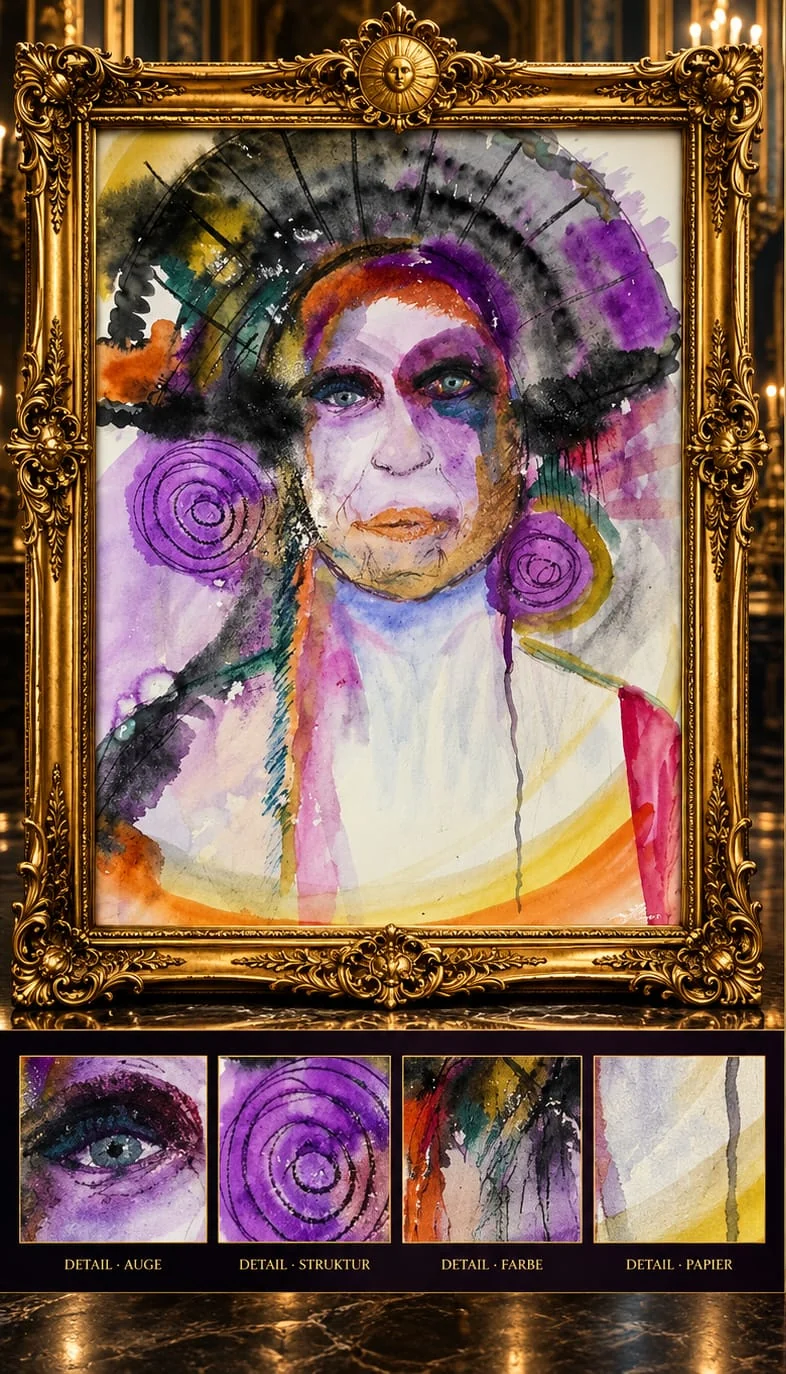
This portrait combines the historical symbolism of royal appearance with a free, expressive visual language. The central face emerges from a many-layered structure of violet, black, ochre and luminous accents of colour. It appears at once present and remote – as if it were less the depiction of an individual person than the embodiment of a timeless identity.

The visual language: face, ornament and movement

The countenance is enclosed by a sweeping, almost crown-like form. Dark, radiating lines give this form a monumental effect. The violet spirals at the sides form ornamental counterpoles to the face and recall the historical connection of jewellery, insignia and symbolic representation.

The transparent, flowing manner of painting stands in a relationship full of tension with the strong black contours. The face remains recognisable, while its surroundings pass into gestural traces of colour and abstract structures. It is precisely this contrast between physiognomic clarity and painterly dissolution that shapes the individual character of the work.

Louis XIV – the royal principle in the present

In the context of Louis XIV, the portrait gains a further meaning. The Sun King made art a central part of his cultural vision. In Versailles, architecture, painting, ornament and ceremonial were joined into an all-embracing aesthetic of royal representation.

The present work translates this historical aspiration into a modern visual language. The crown-like silhouette is not used as a historical attribute in the narrower sense, but as the sign of a higher idea: dignity, presence and the construction of cultural identity. The expressive colour dissolves the traditional courtly form and carries it over into a contemporary pictorial world that is open to subjective interpretation.

Thus Louis XIV becomes not merely a historical point of reference, but a cultural principle through which the transformation of power, beauty and artistic expression can be examined.

Value to collectors and cultural significance

The distinctiveness of this work lies in the combination of royal symbolism and expressive modernity. It offers collectors an approach that goes beyond the decorative effect of the portrait: the work connects the historical idea of the representative countenance with an open, contemporary interpretation of identity and rule.

The characteristic colouring, the ornamental spirals and the dynamic line work give the work an independent visual presence. At the same time, its symbolic openness allows different readings – as a portrait, as a modern allegory and as a reflection on the survival of historical principles of art.

Its particular appeal to collectors lies in the transformation of the royal idea of art into a personal, modern visual language. The work does not simply preserve the memory of a past epoch, but opens a new dialogue between historical heritage and the artistic present.

Die doppelte Maske der Ewigkeit

ART ANALYSIS: Die doppelte Maske der Ewigkeit

LOUIS XIV. – Die doppelte Maske der Ewigkeit

Royal staging, identity and the transformation of Baroque aesthetics of power

This work unfolds an opulent pictorial world in which the visual language of the French court meets a contemporary engagement with identity, representation and cultural continuity. The composition combines royal blue, luminous gold and the repetition of the human countenance into a staging of extraordinary symbolic density.

The crown as a sign of cultural power

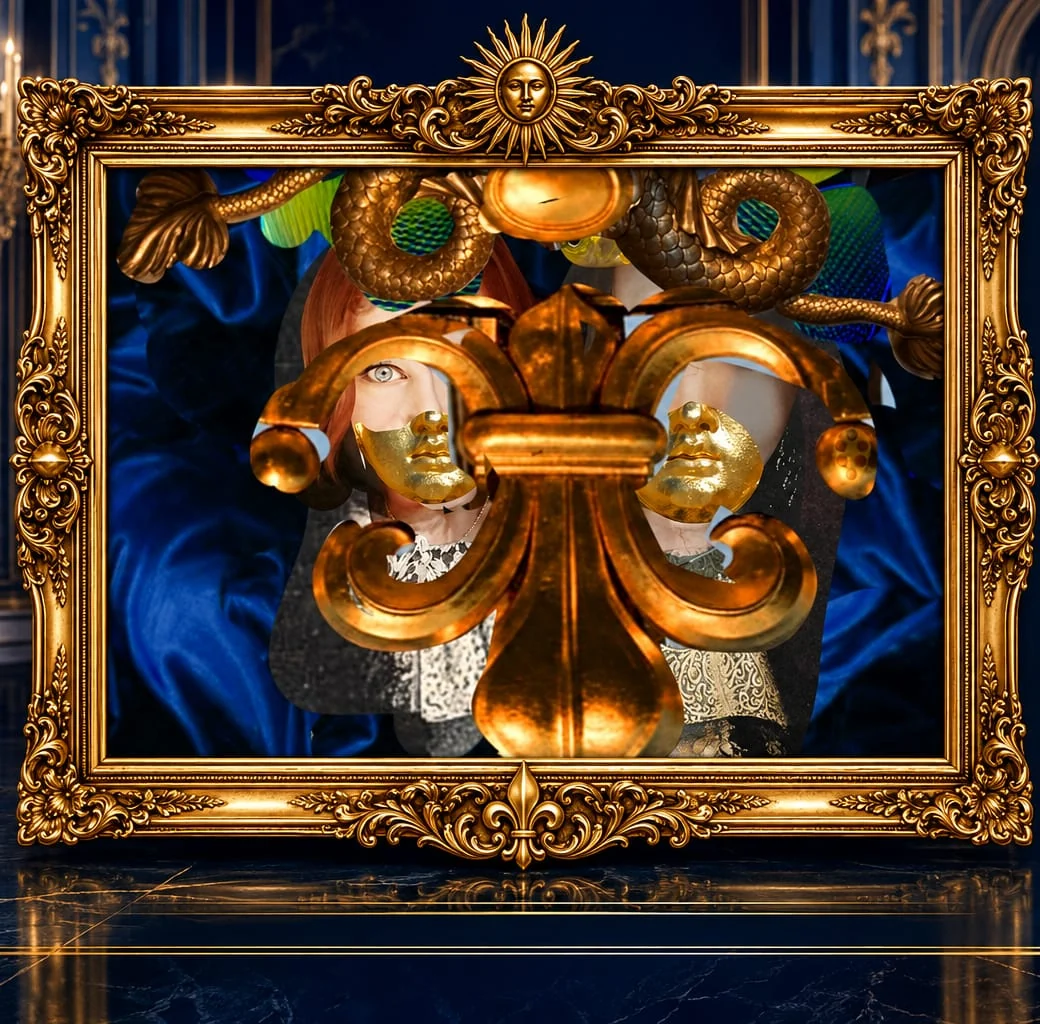
Two golden crowns dominate the upper half of the picture. Their symmetrical arrangement creates a monumental order, while the characteristic lily forms immediately recall the French monarchy. The deep blue of the textile surroundings heightens the effect of the gold and calls up the ceremonial splendour of French court culture.

The crown appears here not merely as a sign of rule. It becomes the symbol of a cultural principle: the connection of power, aesthetic order and historical self-staging. In the tradition of Louis XIV, this symbolism gains a particular resonance, since Versailles embodied the idea that art and representation together can form an all-embracing cultural vision.

The double countenance – identity between appearance and symbol

At the centre stand two faces arranged almost as mirror images. Their repetition creates a tension between unity and difference. The golden masks over mouth and chin heighten this effect: the natural countenance is partly concealed and at the same time transformed into a precious, almost sculptural sign.

The faces thereby appear at once individual and archetypal. They point to the question of how identity is shaped by outward signs, social roles and historical images. The mask becomes the interface between the human being and their public appearance.

The repetition of the face can at the same time be read as a reflection on permanence and change. While the physiognomy remains human and immediate, the gold lends it a symbolic distance that recalls the timeless staging of monarchical dignity.

Versailles in the 21st century

The particular significance of the work lies in its transformation of historical court aesthetics. The royal blue, the lily ornament and the golden insignia are not used as mere historical decoration. They are carried over into a modern photomontage in which repetition, layering and visual condensation reinterpret the traditional forms.

Louis XIV thus becomes the cultural point of reference for a present-day artistic position. The historical heritage appears not as closed, but as a continuing source of aesthetic ideas. The Baroque idea of an all-embracing artistic vision here meets a modern question: how can a historical world of symbols gain new meaning in the present?

Value to collectors and cultural significance

For collectors, the particular appeal lies in the clearly recognisable connection of French royal symbolism and a contemporary visual language. The work has a strong visual presence and at the same time a conceptual level that opens questions of identity, power and cultural memory.

The double crown, the mirrored faces and the golden masks create a memorable visual ensemble. At the same time, the composition allows an art-historical reading that goes beyond the decorative effect and places the work in the context of the modern reinterpretation of European court art.

The central appeal to collectors lies in the idea of not reproducing the cultural heritage of Louis XIV, but transforming it into an independent visual language of the 21st century. Historical symbolism becomes the material of a new artistic statement – between royal dignity, staged identity and contemporary reflection.

Das Antlitz zwischen Maske und Macht

ART ANALYSIS: Das Antlitz zwischen Maske und Macht

LOUIS XIV. – Das Antlitz zwischen Maske und Macht

A contemporary interpretation of royal identity

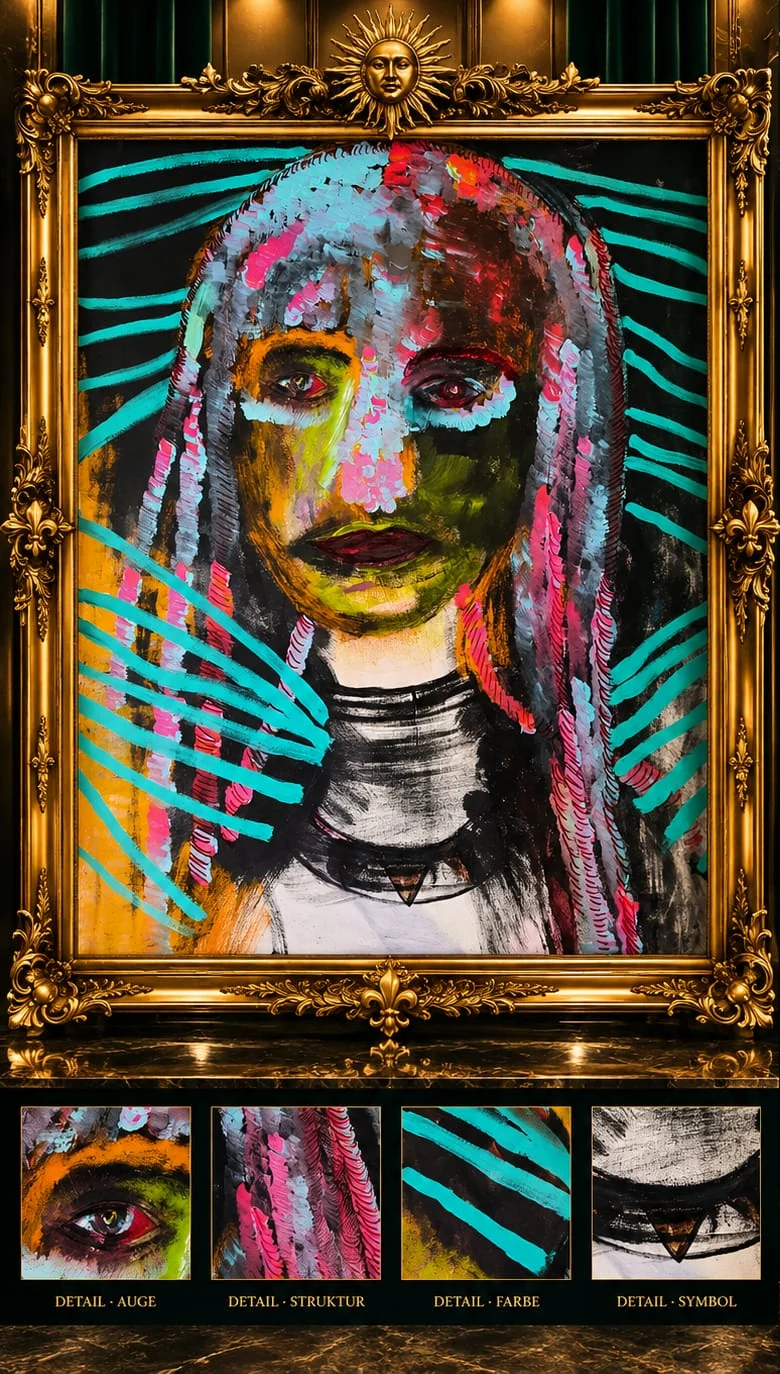
This expressive portrait combines psychological presence with a powerful visual language rich in contrast. The face stands at the centre of a composition marked by luminous turquoise, intense pink, dark violet and earthy tones. The visible brushstrokes and the deliberately fragmented modelling give the countenance a tension between recognisability and dissolution.

The mask as a sign of identity

The partly concealed surface of the face forms the conceptual centre of the work. While the eyes stand out immediately and insistently, nose and mouth remain hidden in a muted, almost mask-like zone of colour. From this arises a contrast between visibility and secrecy, individual appearance and symbolic identity.

The turquoise lines run through the pictorial space like a rhythmic structure. They do not merely frame the face, but seem at the same time to protect and to confine it. The countenance thereby appears as part of a higher structure in which freedom and order struggle with each other.

Louis XIV – the royal principle in a modern visual language

In the cultural context of Louis XIV, the motif of the mask gains a further meaning. The court culture of Versailles developed a highly differentiated language of appearance: clothing, bearing, ceremonial and portrait served to make identity visible and at the same time to exalt it symbolically.

The work carries this question over into the present. In place of the closed Baroque form of representation comes an expressive, fragmented visual language. The historical idea of the representative countenance is not repeated, but reinterpreted. Identity appears as something that arises between inner being and outward staging.

Thus Louis XIV becomes the cultural point of reference for a contemporary engagement with dignity, appearance and the power of visual signs.

Value to collectors and artistic relevance

The strength of this work lies in its unmistakable dramaturgy of colour and the consistent connection of portrait and abstraction. The luminous turquoise lines carry far, while the differentiated layers of colour in the face reward a closer look.

For collectors interested in the transformation of historical forms of representation into modern art, the picture opens an approach of its own. It connects the cultural memory of courtly pictorial traditions with a present-day, expressive interpretation of identity.

Its particular appeal to collectors lies in the tension between the visible countenance and the hidden self. The work turns the portrait into a reflection on the question of how identity is depicted, protected and at the same time created anew.

Within a collection that understands the artistic heritage of Louis XIV as a living cultural principle, this work can set a striking contemporary accent.

Die Krone der Transformation

ART ANALYSIS: Die Krone der Transformation

LOUIS XIV. – Die Krone der Transformation

Royal symbolism between power, identity and cultural eternity

This work stages the royal principle as a complex interplay of rule, identity and symbolic transformation. Golden masks, faces arranged as mirror images and a monumental, ornamentally shaped central form merge into a composition that carries historical representation over into a contemporary visual language.

The composition – symmetry and staging

At the centre rises a golden form of architectural appearance, recalling a throne, a portal or a ceremonial sign of rule. Its symmetrical design gives the composition stability and monumental presence. At the sides appear two faces whose golden masks mark the boundary between individual physiognomy and symbolic appearance.

Above the central structure a golden serpent winds. As a symbol rich in tradition, it can stand for transformation, renewal and the cyclical movement of time. Its counterpart is the deep royal blue, which opens the pictorial space and intensifies the metallic radiance of the gold.

The composition lives from the tension between strict symmetry and the many layers of its pictorial fragments. The ornamental elements create a visual density that leads the eye back to the centre again and again.

Louis XIV – the royal principle as a creative force

In the context of Louis XIV, the work unfolds its particular cultural dimension. Under his rule, art became an essential bearer of political representation and cultural identity. Versailles embodied the aspiration to join architecture, ornament, the visual arts and ceremonial into an all-embracing aesthetic order.

This work does not take up the historical heritage as mere decoration. It carries the royal visual language over into a modern composition in which mask, serpent and architectural central form open new levels of meaning. The historical claim to permanence and order meets a contemporary idea of identity as an ongoing process of transformation.

Louis XIV appears here as a cultural principle: as the emblem of an art that conveys a broader vision beyond its immediate appearance.

Value to collectors – a dialogue between history and the present

The particular appeal of the work lies in its combination of French royal symbolism, ornamental opulence and conceptual ambiguity. The golden central form gives the picture a strong visual authority, while the double faces and the serpent widen the space for interpretation.

For collectors interested in Versailles, Louis XIV and the contemporary development of European court aesthetics, the work offers an approach of its own. It can be read as a modern allegory of rule and identity and at the same time as a visual engagement with the survival of historical principles of art.

Its appeal to collectors lies in the transformation of royal symbolism into a contemporary pictorial vision. Historical tradition is not simply repeated, but carried over into a new form in which power, renewal and cultural continuity are joined together.

The work thus positions itself within an artistic idea that understands the heritage of Louis XIV as a living source of present-day creation.

Louis 14.

ART ANALYSIS: Louis 14.

Louis 14.

New interpretation with “Louis XIV” as context:

With the note that the Sun King is meant by “Louis 14.” in the picture, the artwork takes on an entirely new, historical-political dimension. It is now less about an individual self-image and much more about power, representation, the display of splendour and self-staging – central themes of the Baroque and of absolutist rule.

Updated picture analysis with a focus on Louis XIV

1. The Sun King as a mask

The face in the middle is not a real person, but an iconic symbol – it stands for absolute power, representation and the almost divinely charged figure of the king.

The golden mask recalls the cult around Louis XIV, who staged himself as the “Sun King” – as the centre of the state, as a living sun around which everything revolves.

2. The overwhelming Baroque

The sumptuous frame with angels, ornament and glassy rays strongly recalls the Baroque display of splendour of the Palace of Versailles or sacred iconography.

This Baroque collage visualises the message:

Power arises not only through force – but through staging.

3. The dove as divine providence or critique

The dove, often a symbol of the Holy Spirit, could represent an irony or ambivalence here:

Is Louis XIV an envoy of God?

Or is the divine legitimation only a façade?

4. Contemporary rupture

The collage technique, with its digital look and overlaid motifs, suggests a critical reassessment of historical structures of power.

A field of tension arises between:

  • Baroque splendour (wealth, power, myth)
  • And modern deconstruction (transparency, superimposition, unmasking)

Interpretation: what is the picture trying to say?

“Louis 14.” is not a historical portrait, but a reflection on power as staging.

The golden mask stands for the “theatre of monarchy”, in which the self disappears behind a divinely charged image.

Through the digital technique and the overlaying with symbols such as the dove, Louis XIV is not only quoted, but questioned, dissolved, retold – as a human being behind the mask, as a construction in an image machine.

LOUIS – the golden ratio between the Renaissance and contemporary Baroque

A comparative picture analysis of Albrecht Dürer and Renata Nada’Elena Turanova

How do the Renaissance and contemporary art meet in the geometry of the human face?

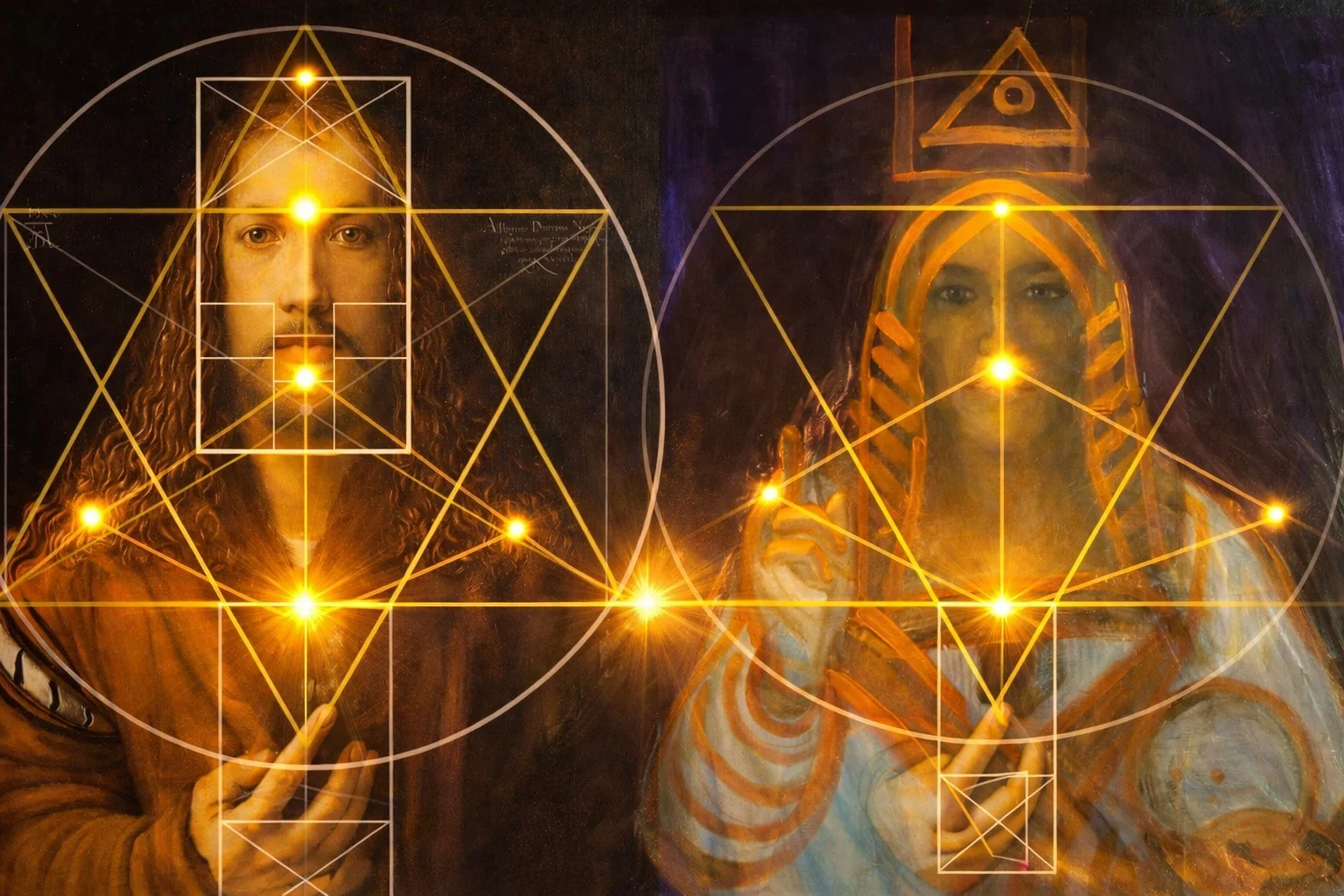
The artwork “LOUIS” (2017) by Renata Nada’Elena Turanova opens a visual dialogue with Albrecht Dürer’s famous self-portrait of 1500. Both works place the face at the centre of a strictly structured composition. The supplementary geometric analysis makes visible possible relationships of proportion, central axes and points of intersection.

1. The vertical central axis

A central line runs through the forehead, the bridge of the nose and the mouth. It makes clear the importance of symmetry and the alignment of the face. In “LOUIS”, it connects the golden masking with the ornamental crown and creates a visual unity between the face and the Baroque staging.

2. The horizontal points of intersection

The horizontal lines drawn in make it possible to examine the position of the eyes, the nose area and the mouth in relation to the overall composition.

The glowing dots mark selected points of reference. They make it easier to compare the two works and show how the structure of the face can be made legible through geometric lines.

3. The golden ratio – 38.2% and 61.8%

The golden ratio describes a proportion of approximately 1 : 1.618. Its points of division lie at 38.2% and 61.8% of a line segment when it is divided according to the golden ratio.

The dividing lines drawn in serve to examine possible relationships between the proportions of the face and the picture surface. Whether these relationships in the original actually correspond exactly to the golden ratio must be measured on the undistorted image files.

4. Circles, triangles and geometric order

The circles and triangles illustrate possible geometric relationships between the face, the direction of the gaze and the ornamental surroundings. While Dürer’s portrait is marked by a concentrated, calm presence, “LOUIS” connects the face with a many-layered Baroque ornament and a contemporary digital visual language.

Geometry here is not merely an analytical aid. It itself becomes an aesthetic element that structures the perception of the artwork.

5. The artistic independence of “LOUIS”

The comparison with Dürer is not a claim that his construction was taken over directly. Rather, it opens an art-historical perspective on the question of how proportion, frontality and symmetry contribute to the effect of a face.

In “LOUIS”, historical pictorial traditions meet gold, mask, light and digital layering. The face becomes the centre of a symbolic composition in which the Renaissance, Baroque representation and contemporary art meet.

Conclusion

The geometric juxtaposition makes the formal similarities and differences between Dürer’s self-portrait and “LOUIS” clear to see. The marked points of intersection are an invitation to look at the composition more closely and to discover anew the importance of proportion and symmetry.

The presentation is a comparative visual analysis.

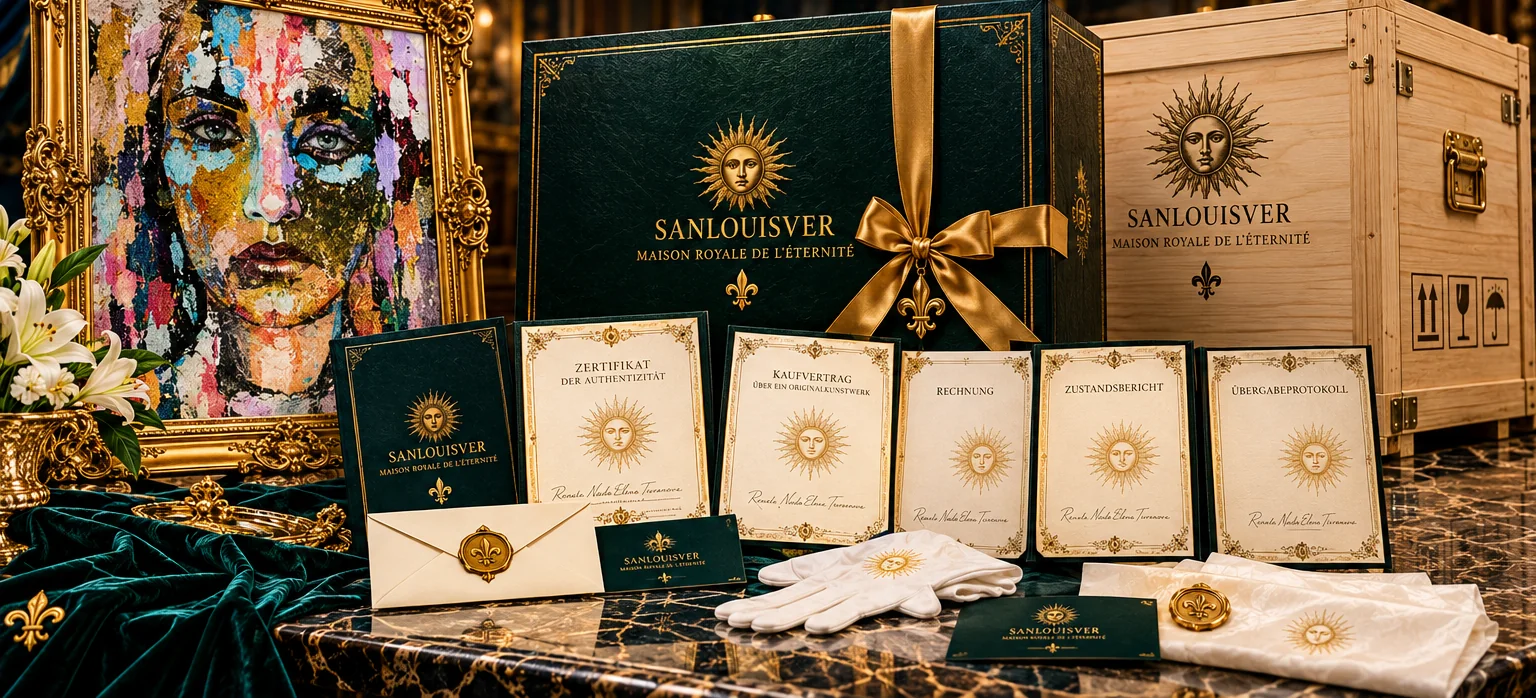
WHAT YOU RECEIVE WHEN YOU BUY AN ORIGINAL ARTWORK

A UNIQUE WORK. A COMPLETE DOCUMENTED ART PACKAGE.

A painting in a gold frame, a green casket with a gold bow, a wooden crate and five documents on a marble table
  • Certificate of authenticity
  • Purchase contract for an original work of art
  • Invoice
  • Condition report
  • Handover record

ART CULTURE HUMANITY

A NEW EPOCH

ENQUIRE BY EMAIL

RIGHT OF WITHDRAWAL

L’ART, C’EST MOI.